Welcome. I'm Dr. Nick.
How We Are
For much of my life, I have been interested in questions about identity, spirituality, relationships, community, healing, and human development.
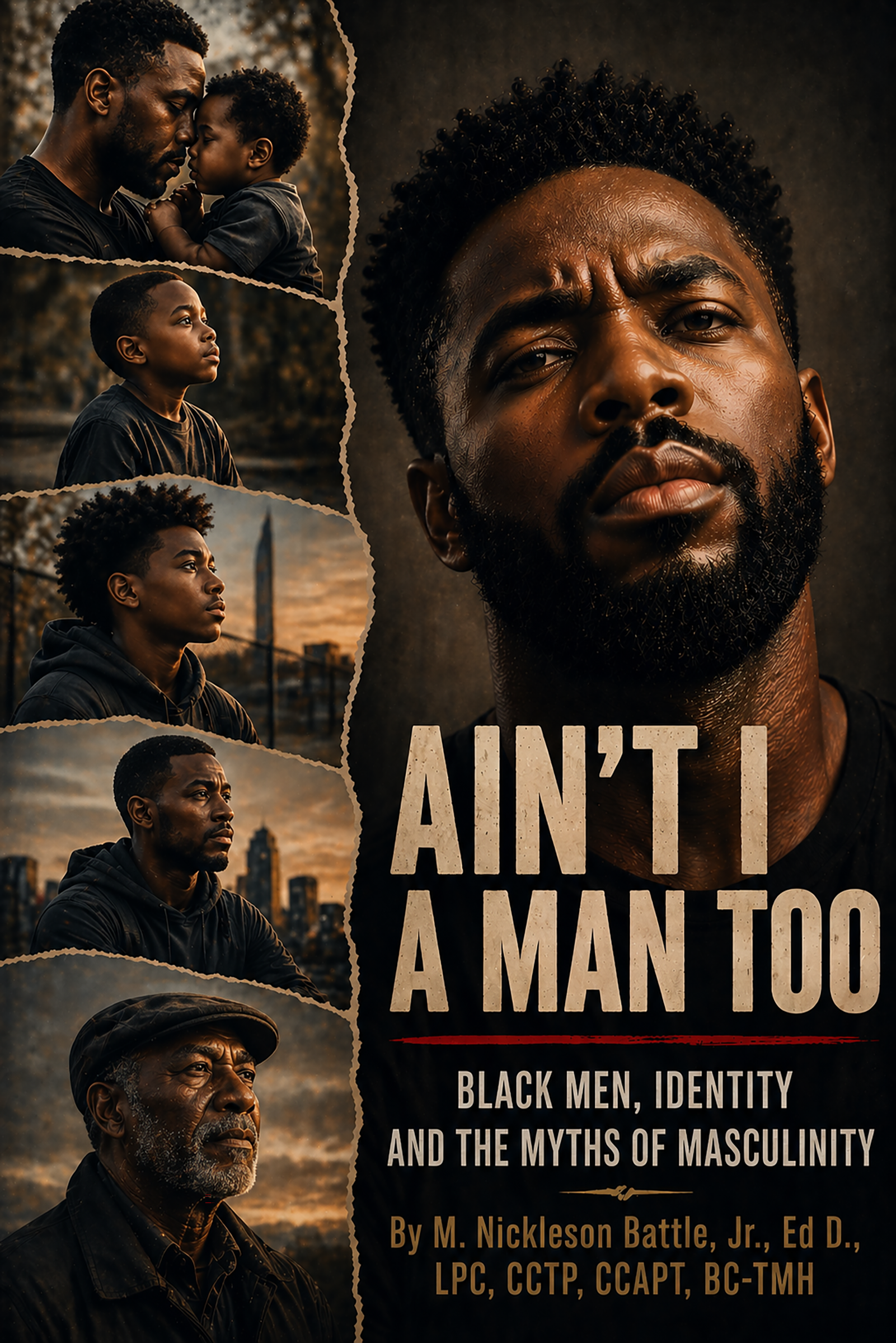
New Book Release
Ain't I A Man Too?
Black Men, Identity and the Myths of Masculinity
NOW on Amazon, Barnes and Noble and other online book retailers!
This book examines the relationship between Black male identity, cultural expectations, and societal narratives surrounding masculinity. It introduces the Culturally Aligned Masculinity Model and the Culturally Aligned Masculinity Assessment as part of a larger conversation about culture, connection, identity, healing, and how Black men show up in the world.
The Question Behind the Work
How We Are
Whether I am writing about masculinity, teaching, counseling, conducting research, speaking, or developing frameworks like CAMM and CAMA, I often find myself returning to one central idea.
The question is not only who we are, but how we are.
How We Are
How we are showing up for ourselves. How we are showing up for the people we love. How we are showing up in our relationships, families, and communities. For a long time, I thought the more important question was, "Who are we?"
But over the years, I began to realize that I was becoming more interested in how we are.
Many of us spend a great deal of time focused on who we are. We define ourselves through titles, roles, responsibilities, identities, and the stories we tell about ourselves. Those things matter, but they do not tell the whole story.
Who we are often describes the roles we occupy. How we are reveals the way we show up in those roles. It reveals how we treat people. How we care for ourselves.
How we navigate relationships. How we engage with our communities.
How we respond to challenges, opportunities, and change. In many ways, the respect, trust, and connection we seek are shaped less by who we say we are and more by how we consistently show up in the world.
Those questions have shaped my work as a counselor, educator, author, researcher, and framework developer. They have also shaped my life. This website is a place where I share some of what those questions have taught me, and some of the questions I am still exploring.
The Work
How These Questions Became My Work
Over time, the questions that shaped my life also began to shape my work.
As a counselor, educator, researcher, and author, I found myself returning to many of the same themes again and again. I became interested in how people develop a sense of identity, how culture and community influence that process, how relationships shape our lives, and how spirituality shapes our understanding of meaning, purpose, and connection.
The more I listened to people's stories, the more I realized that these experiences rarely exist in isolation. Our spirituality influences how we understand ourselves. How we understand ourselves influences how we show up in relationships. Our relationships influence how we engage with our communities.
Our communities shape the stories we tell about ourselves, our relationships, and our place in the world. Each part shapes and is shaped by the others.
Many of the books I have written, the research I have conducted, the conversations I have facilitated, and the frameworks I have developed emerged from exploring those connections. Over time, I became less interested in studying individual topics and more interested in understanding the relationships among them.
CAMM
From Observation to the Culturally Aligned Masculinity Model
As I studied men, particularly Black men, and reflected on my own experiences and years of counseling work, I began to notice recurring patterns. In my dissertation research on men and masculinity, four dimensions consistently emerged: Spirituality, Self, Relationships, and Community.
What stood out was not simply that these dimensions existed, but that they were constantly interacting with one another. How men understood themselves influenced their relationships.
Relationships influenced their communities. Communities shaped identity. Spirituality influenced all of them. Those observations eventually became the foundation of the Culturally Aligned Masculinity Model.
CAMM did not begin as an attempt to define masculinity. It emerged from an effort to better understand how men experience masculinity within the contexts of culture, relationships, spirituality, and community.
Learn More About CAMMCAMA
From CAMM to CAMA
As conversations about CAMM continued, I began looking for ways to help people engage the framework more personally. That led to the development of the Culturally Aligned Masculinity Assessment.
CAMA was developed from CAMM as a reflective tool that helps men explore how the dimensions of Spirituality, Self, Relationships, and Community are showing up in their lives. It is not a diagnostic tool.
It is not intended to label people. Its purpose is reflection, awareness, and conversation. Like CAMM, it is grounded in the belief that understanding ourselves requires understanding the relationships, communities, experiences, and values that shape us.
Learn More About CAMAMy Philosophy
On Expertise, Questions, and Learning
I believe we live in a culture that places too much emphasis on the idea of expertise. The term expert is often used as though a person can arrive at a point where they possess complete knowledge or understanding of a subject. Human experience has taught me otherwise.
The more we learn, the more we discover how much remains unknown.
I do not believe any of us can truly become experts in the complexities of human behavior, identity, culture, faith, healing, or personal growth. These subjects are constantly evolving because people are constantly evolving.
My work is grounded in curiosity, humility, and a commitment to lifelong learning. Whether I am writing, teaching, counseling, conducting research, or speaking with others, my goal is not to provide all the answers. My goal is to encourage deeper understanding and more meaningful conversations.
Progress begins when we are willing to learn from one another, challenge our assumptions, and remain open to new perspectives.